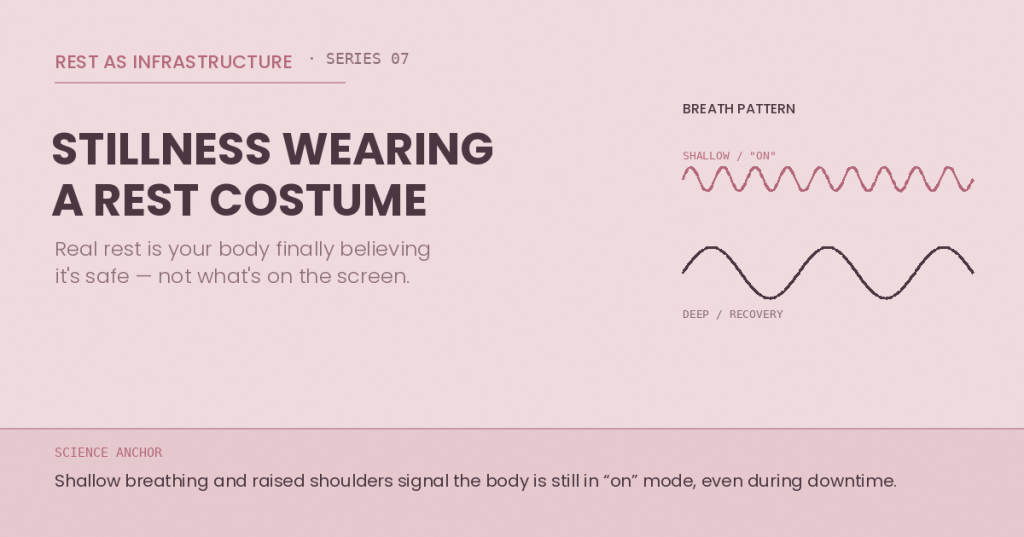
You sit down for your show. Shoulders climbing toward your ears, jaw set, breath staying high and quick in your chest. Two episodes pass. You get up, and somehow you’re just as wired as when you sat down — maybe more, because now you also feel vaguely guilty for “wasting” the evening on something that didn’t even work.
Here’s what actually happened: you weren’t resting. You were being still while your body stayed fully on duty.
Stillness and rest look identical from the outside. Someone glancing at you on the couch would call it downtime either way. But your body isn’t tracking what you’re doing. It’s tracking whether it’s safe enough to stand down — and a still body with tight shoulders and shallow breath is telling itself, thousands of times a minute, that it isn’t.
What’s Actually Happening: Rest Is Defined by State, Not Behavior
The instinct is to define rest by the activity: watching a show, lying down, scrolling, “doing nothing.” But activity is the wrong unit of measurement entirely. Rest isn’t something you do. It’s a physiological state your nervous system either enters or doesn’t, regardless of what your hands and eyes are occupied with.
The relevant switch here is the autonomic nervous system, which runs on two competing branches. The sympathetic branch is the activation system — it’s what speeds your heart rate, tightens your muscles, and shortens your breath when your body is mobilizing for something. The parasympathetic branch is the recovery system — slower heart rate, looser muscles, longer exhale — and it’s the one that has to be active for anything you’d actually call restorative to happen: digestion, tissue repair, the kind of mental defragmenting that makes you feel like a different person the next morning.
These two systems are, for practical purposes, a seesaw. When one is running the show, the other is suppressed. Which means the real question isn’t “am I doing a restful activity right now.” It’s “which branch of my nervous system is actually in charge right now” — and your body will answer that question honestly, whether or not your calendar agrees.
The Body Doesn’t Lie, Even When the Activity Does
Two signals give this away almost immediately, and both are worth learning to notice in yourself.
Shallow, high breathing. When your body shifts into sympathetic activation, breathing moves up into the chest and gets faster and shallower — a pattern that makes sense when you’re actually mobilizing for effort, but that most people carry as a default, all day, without ever triggering an obvious threat. Here’s the part that matters most: this isn’t only a symptom. It’s also a cause. Shallow chest breathing itself signals the brain that something is still unresolved, which keeps the sympathetic branch engaged — a feedback loop where the breath and the stress state keep re-triggering each other. You can be sitting motionless on a couch and still be feeding that loop with every breath.
Raised, held shoulders. Muscle tension is part of the same activation pattern — the body keeping itself primed even when there’s nothing to physically brace against. Shoulders creep toward the ears, the jaw sets, the hands stay slightly curled. None of it requires a real threat in the room. It only requires a nervous system that hasn’t gotten the signal to stand down.
Put those two together — shallow chest breathing and raised shoulders — and you have a body running its activation system in real time, no matter how still the rest of you looks. The show, the couch, the “downtime” on the calendar were never going to override that. Behavior doesn’t out-rank physiology.
Why This Is Especially Easy to Miss for High Performers
If you’ve spent years operating in a baseline state of mild activation — tight shoulders, shallow breath, a slightly quickened pulse — that state stops registering as unusual. It just becomes what “awake” feels like. Which means the absence of relaxation doesn’t announce itself. There’s no alarm. You simply never notice that the sympathetic branch has been quietly running the show through dinner, through the show, through the sixty seconds before you fall asleep.
This is also why so much scheduled downtime fails to deliver anything. It’s not that watching TV or scrolling can’t be restful — it’s that most people do them without ever checking whether the nervous system actually shifted, so the same tight, shallow, activated pattern just gets relocated from the desk to the couch. You changed the scenery. You didn’t change the state.
Reframing the Fix: Ask the Body, Not the Calendar
The usual approach treats rest as a scheduling problem: block the time, choose a low-effort activity, call it recovery. That’s necessary but not sufficient, because it only ever addresses the “what.” It never checks the “how.”
The reframe: before you can trust that something counted as rest, you need a body-based way to check, not just a calendar-based one. Two questions do most of the work: Where is my breath right now — high and short, or low and long? Where are my shoulders right now — climbing, or dropped? Those two answers tell you more about whether you’re actually resting than the name of the activity ever will.
This matters because it puts the locus of control somewhere useful. You can’t always control your workload, your inbox, or how long the day runs. You can, with practice, notice your breath and shoulders in real time and use them as an honest instrument — one that doesn’t care what you meant to be doing, only what your body is actually doing.
What This Means for the Four Things You’re Actually Trying to Fix
Guilt-free rest. A lot of rest-guilt comes from a vague sense that downtime “isn’t working,” which it often isn’t, because the activity was never checked against the actual physiological marker. Once you can verify the state directly, the guilt has something concrete to resolve instead of just lingering.
Faster recovery from burnout. Burnout is, in part, a nervous system stuck in prolonged activation. Learning to detect sympathetic dominance early — via breath and shoulders — gives you a daily, low-effort way to catch the pattern before it compounds into something that takes weeks to unwind.
Sustainable energy. Time spent in a still body that’s still sympathetically activated doesn’t recharge anything; it just relocates the drain. Real parasympathetic time is where energy actually gets replenished, which means verifying the state is what makes rest time count toward your energy budget at all.
Nervous system regulation. This entire piece is nervous system regulation, described at the most concrete level available: noticing which branch is currently running, and using breath as one of the few levers you have direct, voluntary access to for shifting it.
How to Actually Check (and Shift) the State
Run a 10-second body check before you assume you’re resting. Notice your breath’s location and your shoulders’ height. If both are activated, the activity you’re about to do won’t do the work on its own.
Lengthen the exhale, not just the inhale. A longer exhale relative to the inhale is one of the more direct ways to nudge the nervous system toward the recovery branch — a few slow breaths with an extended exhale before you sit down for downtime, not just during a crisis.
Drop the shoulders on purpose, more than once. They’ll creep back up. That’s fine — the point isn’t to hold a perfect posture, it’s to keep interrupting the default activation pattern often enough that your body gets more practice being in the other state.
Stop trusting the activity label. Rename the block on your calendar from “relax” or “watch TV” to “check nervous system state,” and let the actual activity be secondary to whether the check comes back showing activation or recovery.
Notice what genuinely resets you versus what just occupies you. Some activities reliably drop your shoulders and slow your breath. Others don’t, no matter how many episodes you watch. Start keeping track — the pattern is usually more specific and more personal than generic rest advice accounts for.
Frequently Asked Questions
Does this mean watching TV is never restful? No — it means the activity itself doesn’t guarantee the state. Plenty of people do shift into genuine parasympathetic recovery while watching something; the point is to verify it rather than assume it, since the same activity can land completely differently depending on where your breath and shoulders already are when you sit down.
How do I know if my breathing is actually shallow, versus just normal for me? A useful rough check: place one hand on your chest and one on your belly. If the chest hand moves noticeably more than the belly hand during normal breathing, that’s a sign your breath has shifted upward into the pattern associated with sympathetic activation.
Can I fix this with one deep breath? A single breath won’t undo a day of accumulated activation, but it’s a legitimate, immediate lever — a few consecutive breaths with a longer exhale measurably nudge the nervous system, even if the deeper pattern needs more than one round to shift.
Rest as Part of Your Performance Stack
The high performers who actually recover aren’t necessarily the ones with the most downtime blocked off. They’re the ones who’ve learned to check whether the downtime is doing anything — using the two instruments that were available the entire time: breath and shoulders. A calendar can tell you when rest was scheduled. Only your body can tell you whether it happened.
Stillness was never the goal. A nervous system that believes it’s safe enough to stand down is.
Put This Into Practice
Knowing to check your breath and shoulders doesn’t make the checking automatic — it’s easy to sit down for downtime and never think to look. I built The Off-Duty Audit, a short body-based workbook for verifying rest instead of assuming it: a Body State Ledger to track breath and shoulders against how activities actually land, a 10-Second Check to run before and during downtime, and a Rest Quality Tracker that separates what actually resets you from what just occupies you.


Leave a Reply