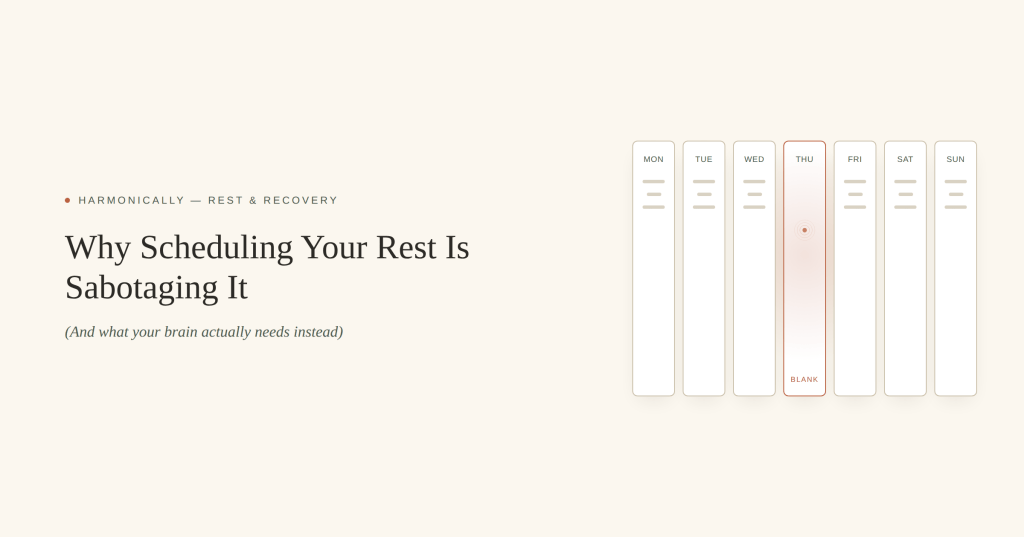
Yoga at 9, journaling at 10, relaxing at 11 — scheduled self-care isn’t the same as real recovery. Here’s why unstructured downtime activates the brain’s default mode network, and why high performers need it.
Why Scheduling Your Rest Is Sabotaging It (And What Your Brain Actually Needs Instead)
Yoga at 9. Journal at 10. Relax at 11.
It looks like a wellness routine. It’s actually a to-do list wearing softer clothes. Every block is still a task — something to start, something to finish, something to check off before the next one begins. You’ve gotten disciplined enough to schedule your own rest, and it still isn’t working. You still finish the day tired, still feel like you never actually stopped.
That’s because you didn’t. You did rest. You didn’t get to rest.
The Difference Between Doing Rest and Actually Resting
A scheduled block of “relaxing” is still structured time. It has a start, an end, and an implicit goal — you’re supposed to feel calmer by 11:15, ready for whatever’s next at 11:16. Your mind treats it exactly like it treats a meeting: something to manage, perform, and complete on time.
Real recovery isn’t a task at all. It’s empty space — nothing scheduled, nowhere to be, no outcome to hit. That blank square, the one your calendar doesn’t have room for, is the part your mind actually needs. Not because unstructured time feels nicer, but because of what it turns on in your brain that structured time — even relaxing, well-intentioned structured time — never does.
What the Default Mode Network Actually Is
Neuroscientists have a name for the brain state that switches on during genuinely unstructured time: the default mode network, or DMN. It’s a set of connected brain regions that becomes active when you’re not focused on an external task — when your mind is wandering, drifting, or simply idle with nothing pulling its attention.
The default mode network is directly linked to creativity, memory consolidation, and problem-solving. It’s the system quietly working in the background when a solution shows up in the shower, or a memory suddenly makes sense in a new way on a walk with no destination. Critically, it only switches on when there’s nothing pulling your focus. The moment you give your mind a task — even a gentle one, even a task called “relax” — the DMN goes quiet and your brain’s task-focused networks take over instead.
This is the part scheduled self-care misses entirely. Yoga at 9 is still a task. Journaling at 10 is still a task. Both are valuable, but neither one is the blank, undirected space where the default mode network actually gets to run. You can do an hour of wellness activities back to back and still never give your brain the one condition it needs for deep recovery: nothing to do.
Why High Performers Fill Every Blank Square by Instinct
If you’re someone who’s built a career on output, an empty square on the calendar doesn’t read as rest — it reads as a gap. Something’s supposed to go there. So you fill it, often with something virtuous: a workout, a class, a habit tracker, a book you’ve been meaning to start. Each one is genuinely good for you. None of them are unstructured, which means none of them let the default mode network switch on.
This is worth naming clearly, because it’s not laziness or poor planning — it’s the opposite. It’s the same drive that makes you good at your work, applied to the one part of your life that specifically requires the drive to switch off. The instinct to optimize every hour, including the recovery hours, is exactly what keeps recovery from actually happening.
Reframing the Fix: Blank Space Is a Competitive Advantage, Not a Void
Once you see the mechanism, the reframe follows naturally. Unstructured time isn’t unproductive time you’re indulging in — it’s the specific condition your brain needs to do work you can’t do on purpose: synthesizing what you’ve learned, processing what happened, and generating the kind of insight that shows up only when nothing is being demanded of you.
Seen this way, protecting a genuinely blank square on your calendar is a competitive advantage, not a luxury. It’s the difference between a mind that’s constantly running structured programs and one that gets regular access to its own background processing. High performers who protect this space aren’t falling behind the ones who don’t — they’re the ones whose best ideas keep showing up, because they’ve left room for the system that produces them.
What This Means for the Four Things You’re Actually Trying to Fix
Guilt-free rest. It’s easier to feel okay with an empty square once you know it’s not doing nothing — it’s running a specific, well-documented brain process. The guilt fades when “unstructured” stops meaning “unproductive” and starts meaning “a different kind of work.”
Faster recovery from burnout. Burnout often comes with a mind that can’t stop generating tasks, even out of its own downtime. Practicing real unstructured time — regularly, deliberately — rebuilds your capacity to be idle without anxiety, which is exactly the capacity burnout erodes first.
Sustainable energy. A calendar packed with back-to-back wellness tasks can be just as depleting as a calendar packed with work, because both keep your task-focused brain networks running all day. Genuine blank space is where those networks finally get to rest, which is where sustainable energy is actually replenished.
Nervous system regulation. Structured tasks, even calm ones, keep a low level of goal-directed activation running in the body. Unstructured time, with nothing to complete, is one of the few conditions that lets that activation fully release — which is precisely what nervous system regulation requires.
How to Actually Protect a Blank Square
Block it like a meeting, but don’t name what happens in it. Put “nothing scheduled” on your calendar the same way you’d protect any important block, without assigning it an activity.
Resist the urge to plan what you’ll do with it. The moment you decide in advance, it becomes a task again. The not-knowing is part of what makes it unstructured.
Let boredom happen instead of solving it immediately. The discomfort of the first few minutes with nothing to do is usually where people reach for a phone or a task. That discomfort is the doorway, not a problem to fix.
Protect it from productive hijacking. A blank hour that quietly turns into “I’ll just tidy the kitchen” or “I’ll just answer one email” is no longer blank. Notice the drift and let it stay empty.
Trust that nothing happening is the point. You won’t always walk away with an insight or a great idea. That’s fine — the default mode network doesn’t perform on command, and treating it like it should just turns the blank square into another task with a hidden goal.
Frequently Asked Questions
Isn’t scheduled self-care still better than no self-care at all? Yes — yoga, journaling, and structured relaxation are all worth keeping. The point isn’t to replace them, it’s to notice they’re solving a different problem. They can improve mood, flexibility, and reflection without ever giving your brain the specific, unstructured condition the default mode network needs. Both belong on the calendar; only one of them can be a blank square.
How long does a block of unstructured time need to be to count? There’s no strict minimum, but very short gaps tend to get swallowed by the urge to check a phone before boredom fully sets in. Twenty to thirty minutes is often enough for the initial restlessness to pass and the mind to actually start drifting, though even a protected ten minutes, practiced consistently, builds the capacity over time.
What if I try this and just feel anxious the whole time? That’s common at first, especially for people who’ve spent years optimizing every hour. The anxiety is usually a sign of exactly how unpracticed this capacity has become — treat the first several attempts as training the tolerance itself, not as evidence that unstructured time doesn’t work for you.
Rest as Part of Your Performance Stack
The highest performers aren’t the ones with the most disciplined self-care schedule. They’re the ones who’ve learned to leave a square genuinely blank and defend it, because they understand that their best thinking doesn’t come from another task — it comes from the space where no task is running at all. That empty square isn’t a gap in your day. It’s where the next idea is actually being built.
You need the confidence to leave one square unscheduled, on purpose, and let your mind do the one kind of work it can only do when nothing else is asking for its attention.
Put This Into Practice
Knowing this doesn’t make it easier to actually protect the square — instinct will still try to fill it. I built The Blank Square, a weekly planner made for exactly that moment: pre-marked blank blocks for every day, a “Guarding the Square” checklist for when the urge to fill one shows up, and a simple weekly line to note what surfaced. It’s the thin layer that turns “I should really protect some unstructured time” into a square that’s already on the calendar, waiting to stay empty.


Leave a Reply