You’re good at your job. You hit the targets, solve the problems, carry the projects other people drop.
But lately, every win costs a little more than the last. The deadline gets met, and you spend the weekend flat. The presentation lands, and you can’t remember the last time you had an idea that wasn’t for work. You’re still delivering. You’re just paying for it with something you can’t easily get back.
That’s not success with a side of tiredness. That’s extraction. You’re mining yourself to produce results.
This post is about a different way to achieve: a new balance where you keep delivering at work, without draining yourself to do it.
The Old Balance Is Broken
The old idea of work-life balance was about splitting time. So many hours for work, so many for life, and if the numbers looked fair, you were balanced.
But you can have a “balanced” calendar and still be running on empty. You can leave at 6 p.m. and spend the evening replaying meetings. You can take a holiday and need a week to recover from it.
The problem isn’t how your hours are divided. It’s how much each hour costs you, and whether anything is being put back.
The new balance isn’t time versus time. It’s output versus recovery. Not “work less,” but “stop spending more than you replenish.”
Max Capacity vs. Rated Capacity
In manufacturing, every machine has two numbers.
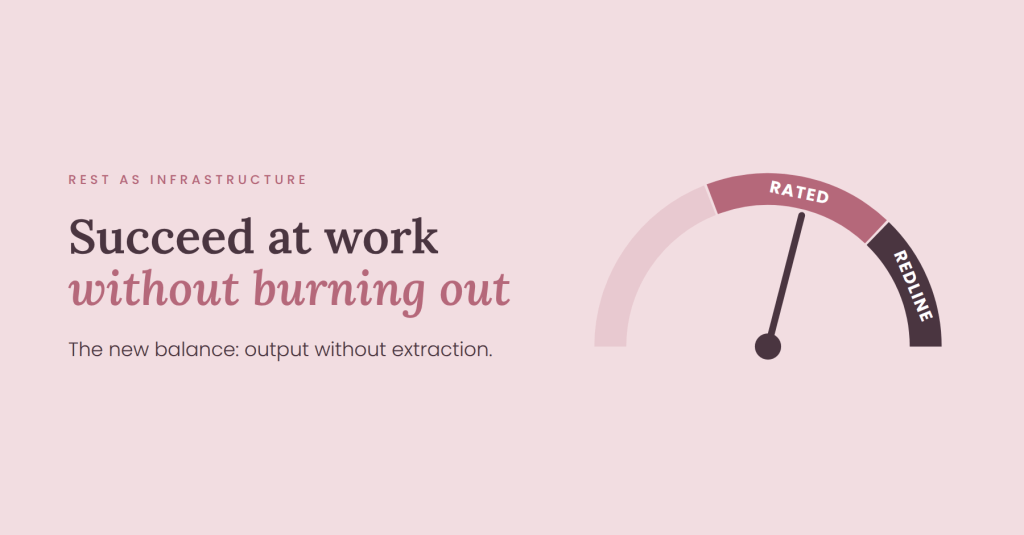
Maximum capacity is the most it can produce when pushed to the limit. Rated capacity is the output it can sustain, shift after shift, without accelerating wear or risking breakdown.
No good plant manager runs critical equipment at maximum all the time. They know what happens: more wear, more defects, and eventually an unplanned stoppage that costs far more than the extra output was ever worth.
Most high achievers run themselves at maximum capacity as their default. Every day is a peak day. Every week is a sprint. And because the output keeps coming, nobody notices the wear, including you, until something gives.
The new balance means finding your rated capacity: the level of output you can sustain while still recovering.
The Mechanism: Why Constant Effort Becomes Extraction
This isn’t just a metaphor. Several well-established models in psychology and physiology describe the same pattern.
Effort has a cost that needs repaying. The Effort-Recovery Model (Meijman and Mulder) describes how working effort triggers short-term load reactions such as raised stress hormones, fatigue and tension. These are normal and reversible, if recovery follows. When recovery doesn’t happen, the load carries into the next day, and the next, and starts to accumulate.
Accumulated load becomes wear. Neuroscientist Bruce McEwen called this cumulative cost allostatic load: the wear and tear that builds up when the body’s stress systems are activated too often, or stay on too long. A stress response that should switch off after the meeting keeps running into the evening.
Demands drain, resources refill. The Job Demands-Resources model (Bakker and Demerouti) explains burnout as what happens when demands consistently outpace resources such as autonomy, support, meaningful work and recovery time. You don’t burn out from hard work alone. You burn out from hard work with nothing refilling the tank.
Switching off is the refill. Sabine Sonnentag’s research shows that psychological detachment — genuinely switching off from work in your own time — is one of the strongest predictors of recovery. If your body leaves the office but your mind doesn’t, the refill never starts.
Put simply: effort isn’t the enemy. Unrecovered effort is.
The Belief That Keeps You at Redline
If the science is this clear, why is it so hard to slow down?
Because for many high achievers, running at maximum isn’t just a habit. It’s an identity. I’m the one who delivers. I’m the one people rely on. If I’m not giving 100%, I’m not really committed.
So running at rated capacity feels like a downgrade, as if you’d become a lesser version of yourself.
Here’s the reframe. The most reliable equipment in any plant isn’t the machine that hits the highest peak. It’s the one that delivers consistent output, year after year, without unplanned breakdowns. Reliability is the real measure of performance. And reliability requires a recovery margin.
You don’t become less capable by operating within your rated capacity. You become dependable, including to yourself.
How to Find Your New Balance: Six Practices
1. Learn your redline signals. In quality engineering, a control chart catches a process drifting before it produces defects. You need the same thing for yourself. What are your early warning signs? Maybe it’s waking at 4 a.m. thinking about work, snapping at small things, needing caffeine to start, or losing interest in anything that isn’t urgent. Write down your signals for “green,” “amber” and “red” so you notice the drift early, not at breakdown.
2. Define “enough” before the day starts. Endless to-do lists keep you at maximum because the finish line keeps moving. Each morning, pick up to three outcomes that would make the day a success. When they’re done, the day’s core output is complete. Anything more is a bonus, not an obligation.
3. Build recovery into the work cycle, not after it. Waiting for the weekend to recover is like waiting for a breakdown to do maintenance. A 2022 meta-analysis by Albulescu and colleagues found that micro-breaks of ten minutes or less were linked to higher vigour and lower fatigue. Between focused blocks, take two to three minutes to step away: slow exhales, eyes off the screen, a short walk.
4. Close the loops every day. A five-minute shutdown at the end of work, writing down what’s open and where you’ll pick it up, gives your brain permission to detach. That’s when the refill starts.
5. Add one resource for every major demand. When a demanding project lands, ask: what resource will balance it? More autonomy over how you do it, support from a colleague, an extra recovery block, or a lighter week afterwards. Don’t just absorb the demand. Match it.
6. Protect one full recovery day a week. Daily recovery maintains you. A weekly rest day restores you. (If that feels impossible, start with [how to take a rest day without guilt].)
What a Rated-Capacity Day Looks Like
It’s still a busy day. The meetings are still back to back, and the decisions still matter. What’s different is how the day is run.
You start with three defined outcomes instead of an endless list. Between meetings, you take three minutes to breathe and look away from the screen instead of opening the next message. When the 3 p.m. slump hits, you treat it as a normal signal and step outside for a few minutes, rather than pushing through on a third coffee and wondering why you’re not stronger.
At 6 p.m. you write down what’s still open and close the laptop. Your attention stays at the office. At dinner you’re actually present, not replaying the day. And when you notice an amber signal, like a 4 a.m. wake-up or a short fuse, you act on it that week instead of waiting for the crash.
Same job. Same ambition. A very different cost.
What Changes When You Run at Rated Capacity
The first thing many people notice isn’t that they do less. It’s that what they do costs less.
Decisions come more easily. You have ideas again. The afternoon slump softens. You come home with something left for the people you love. You still deliver, often better, because your judgment isn’t running on fumes.
That’s the new balance: high achievement without the hidden cost.
If you’re already depleted, with persistent exhaustion, sleep problems or physical symptoms, please talk to a doctor. Sustainable habits help, but they don’t replace proper care.
Frequently Asked Questions
Can you be a high achiever without burning out? Yes. Burnout comes from effort without enough recovery, not from ambition itself. When recovery is built into how you work, high performance becomes sustainable.
What’s the difference between work-life balance and this “new balance”? Work-life balance divides time. The new balance manages cost: how much each workday drains you, and whether you replenish it.
How do I know if I’m running at maximum capacity? Common signs include needing stimulants to function, being unable to switch off in the evening, irritability, and losing interest in anything that isn’t urgent. Track your own warning signals so you can spot the drift early.
Will working at “rated capacity” hurt my career? Usually the opposite. Consistent, clear-headed performance builds more trust over time than peaks followed by crashes.
Your Next Step
You don’t have to choose between achieving and staying well. You just need to stop running at redline.
Rated Capacity is a workbook designed to help you identify your limits, create a personal warning chart, set daily goals, balance tasks with resources, and monitor four weeks of manageable output. [Get the workbook here → Rated Capacity Workbbook]
Related reading: [How to take a rest day without guilt] · [AI saves you time. So why are you more tired?] · [The Deep Rest Protocol]


Leave a Reply